What is the Difference Between BDR and SDR Roles?
Breaking down the real-world differences between Business Development Rep and Sales Development Rep roles, including ADR hybrids, promotion timelines, and when to outsource.
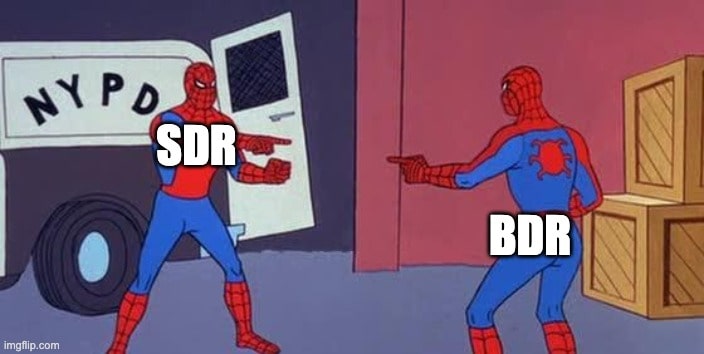
Is there actually a difference between BDR and SDR roles?
In an academic sense, yes there may be a general consensus, distinct difference between the BDR and SDR positions.
In many organizations, it’s as simple as BDR = Outbound prospecting, and SDR = inbound lead qualification and follow up.
In the real world, these two terms often get used interchangeably. Both are front-end-of-funnel roles focused on pipeline generation.
SDRs are often assigned to a specific AE or AEs. BDRs might more typically be assigned to a region, vertical, product, or other specific territory.
In some organizations, SDRs may be focused on SMB companies versus BDRs which are more focused on enterprise level accounts that are more difficult to engage and penetrate.
In some organizations, SDRs are a bit more junior role and BDR more senior.
Sometimes, more sales-focused organizations use SDR (SaaS) while a more services-oriented approach might lean towards BDRs.
One theory is that the “BDR” title stems from a desire to not immediately associate your role with the term “sales” when doing cold outreach to a prospect.
What is an Account Development Rep (ADR)?
An Account Development Rep is a hybrid BDR/SDR role engaged in both following up on inbound leads and outbound outreach. The ADR role makes most sense for B2B companies with larger ARR, where a buying team participates in research and there’s a longer purchase cycle. An Account Based Marketing approach often makes sense here.
An ADR may also have upsell and cross-sell responsibilities to existing enterprise customers.
Other Related Sales Titles
- Market Development Rep
- Lead Development Rep
- XDR - Hybrid BDR/SDR role tasked with both inbound and outbound sales
In the end, these are all titles that an HR or Sales leader may create for very similar roles.
Dangers of Inbound Only Focus for SDRs
Depending on your sales organization size and lead volume, having top of the funnel sales reps solely focused on inbound leads may not be desirable:
-
Developing SDRs: Any sales professional should “Always Be Prospecting.” In many organizations, SDRs are the future Account Executives and Sales Managers. If a rep solely focuses on inbound lead follow up, a dangerous mentality can develop that leads will always be delivered automatically by marketing.
-
Surround Buying Teams at the Account Level: Most B2B purchases involve multiple decision makers. Research and evaluation occur over 3 - 6 months or longer. If your sales organization is 100% focused on just the individual inbound lead, the entire account won’t be effectively nurtured. Good SDRs do account research and send personalized outreach to other key stakeholders.
-
Inbound Only Approach May Not Align with Ideal Customer Profile: If your SDR solely relies on inbound leads, perfect-fit companies may not self-select into your funnel. A classic inbound problem is SDRs’ days being filled with too large a proportion of SMB leads.
What is the Average Time Before a BDR or SDR is Promoted to AE?
This varies by company size and structure, job market conditions, and growth rate. Typically the average time before promotion is 12 - 24 months.
Many companies have a 12-month lock-out period before promotion. This makes sense as these junior roles are often hired and trained as a cohort managed by an SDR Manager.
What are Typical BDR and SDR Goals - Demos or Revenue?
The SDR teams have goals to hit in support of the larger sales organization. This is most typically a set number of demos or Sales Accepted Leads per month versus pure revenue goals. There may be some variable compensation tied to revenue, but the BDR and SDR role gets a layer removed from whether a deal closes or when revenue is recognized. The skill and competence of the AE and revenue recognition complexities are factors out of an SDR’s control. The BDR/SDR role is often high turnover, making it difficult to tie compensation to longer-term revenue targets.
Outsourcing a BDR/SDR Role or Team
Depending on your sales organization and objectives, outsourcing the BDR/SDR function can make sense to drive more demos. GTM Works works with SaaS companies to design and run outbound programs that generate qualified pipeline without the overhead of hiring and managing an in-house team.