Best ChatGPT Detector Apps for 2025
A comparison of the top ChatGPT and AI content detection tools for 2025, plus what you need to know about Google penalties for AI-generated content.
ChatGPT is taking the web by storm, and makes it incredibly easy for B2B marketers to produce increasingly quality content at scale. Beyond ChatGPT, there is an emerging market of AI content generation products to produce marketing content at scale. ChatGPT detector apps have become increasingly popular to detect ChatGPT and other computer generated content. These apps use advanced machine learning algorithms to analyze text, images, and other datatypes. They can be used for many tasks, such as detecting spam, identifying propaganda, and checking for plagiarism.
Whether you are looking to filter out spam emails, check for unoriginal content, or improve your written communication, there is a ChatGPT detector app to suit your needs. In this article, we will explore the Best ChatGPT Detector Apps for 2025, along with Google penalties for AI-produced content.
Google Penalties for ChatGPT Produced Content
Google penalties are measures taken by Google to penalize websites that violate the company’s guidelines for content quality and search engine optimization. These penalties can decrease search engine rankings, which can negatively impact a website’s visibility and traffic. If Google detects AI-produced content on your website, it could in the future be considered spam or low quality content, and you will face the consequences.
Google may improve the quality and relevance of search results by punishing sites that host information generated by artificial intelligence. AI-generated content may face penalties from Google to deter attempts to manipulate search engine results pages by writing fast and cheap content. The quality and relevancy of search results may suffer if AI-generated material can be more readily manipulated to attain better search ranks.
How Reliable are ChatGPT Detection Tools?
The popularity and efficiency of AI detection tools are rising, but how reliable are they? Several aspects affect how accurate AI detection tools are, including the quality of the training data used to construct the tool, the difficulty of the job at hand, and the unique implementation of the tool.
AI detection tools may achieve impressive precision when trained on big, varied datasets and applied to straightforward problems. For example, spam filters powered by AI are usually quite good at detecting and preventing spam emails. However, when it comes to more complicated tasks like spotting propaganda or gauging the tone of a document, AI detection technologies may not be as trustworthy.
ChatGPT Detector Tools Comparison
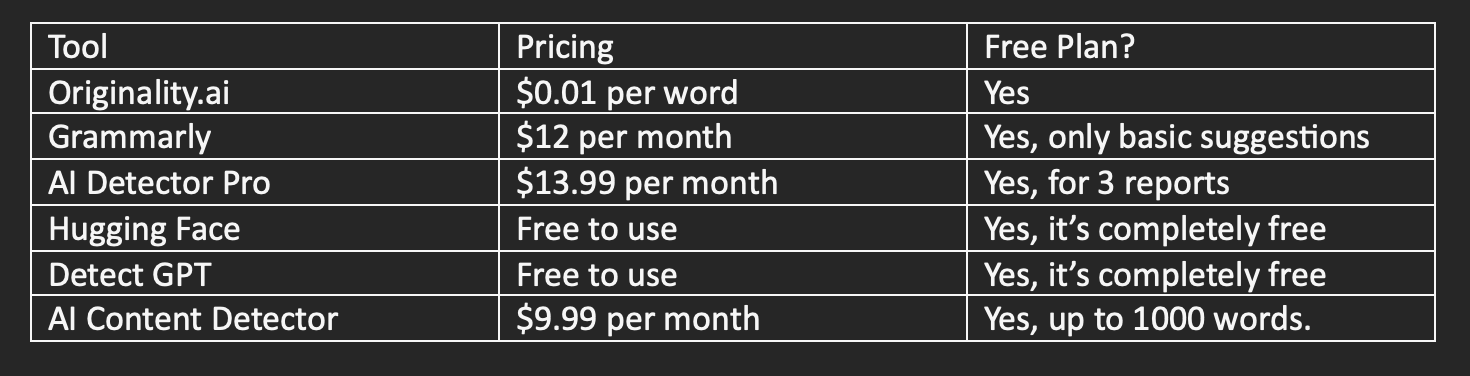
1. Originality.ai
Link: originality.ai
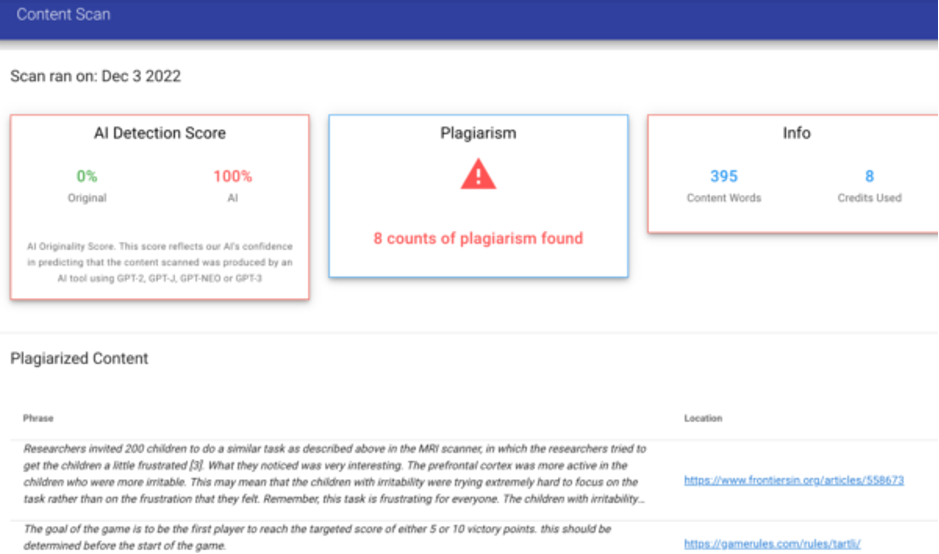
The ChatGPT detector tool from Originality.ai is a plagiarism detection program that analyses text and identifies instances of duplicated or unoriginal material using artificial intelligence and machine learning techniques. The software was created to aid institutions in detecting and avoiding plagiarism in written work.
The artificial intelligence detector at originality.ai analyses a database of more than 50 billion online resources and scholarly articles to identify instances of duplicated text.
Key Features:
- Allows you to detect AI-generated content without any complication
- It comes with a database of over 50 billion resources to analyze your content
- It can help the educational as well as work sectors avoid duplicate content
- It has a plagiarism detection tool to detect plagiarized material
Pros:
- Large database
- Fast and reliable
Cons:
- Prone to false negative flagging
2. Grammarly
Link: grammarly.com
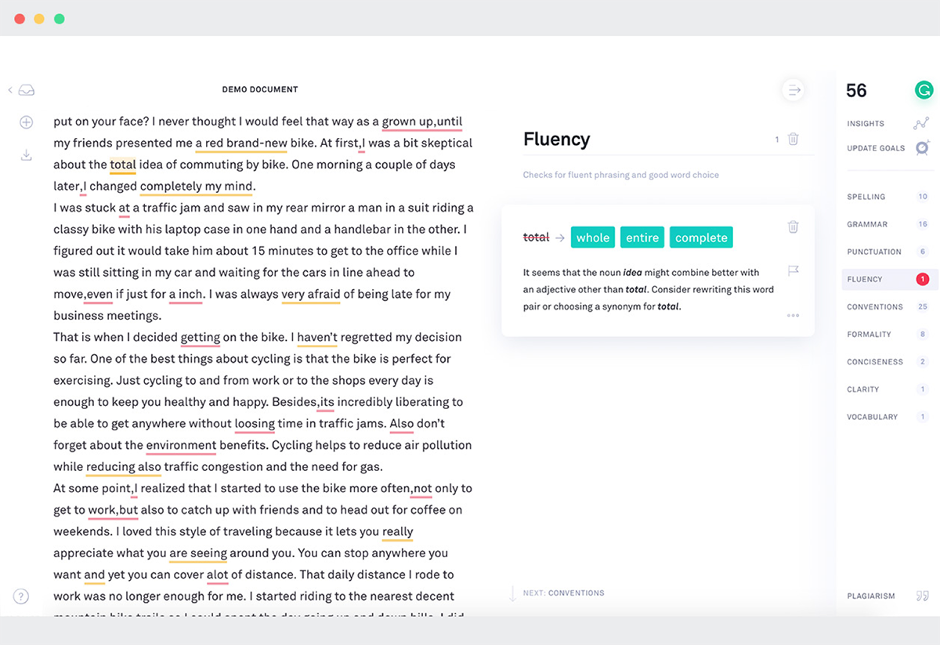
Grammarly is a program that gives grammar and writing help. It offers a variety of tools and features to assist customers in improving their written communication. The Grammarly service not only corrects grammar and spelling but also analyses material for style and tone problems. For those who want even more in-depth criticism of their writing, Grammarly now provides a human review service in addition to its AI detector.
Emails, social media postings, and business papers are just some of the many types of writing that may benefit from this service, which is accessible as either a standalone software or a browser plugin.
Key Features:
- Tool for analyzing text for style and tone issues
- Real-time suggestions for correction as the users are writing
- Available as a standalone software tool or as a browser extension
- It can be used to check a wide range of written materials
Pros:
- Human review
- Includes plagiarism checker
Cons:
- Resource-intensive to use
3. AI Detector Pro
Link: aidetector.pro
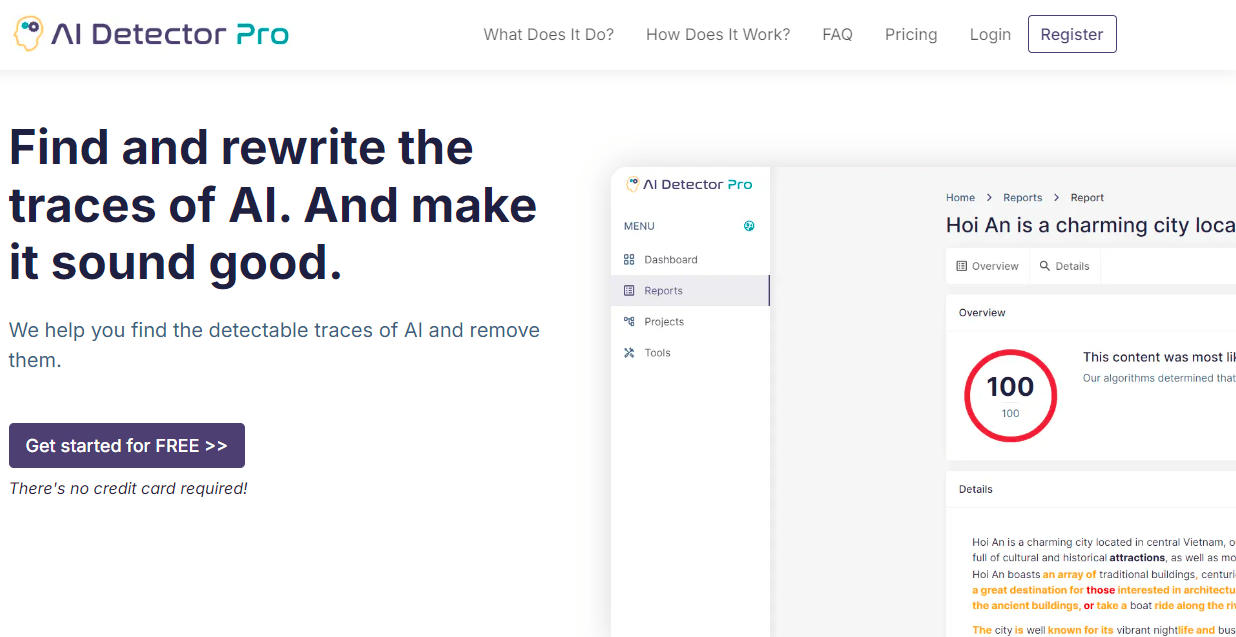
AI Detector Pro is a combination of an AI Detection and Writing platform. Simple detection and humanization platforms ignore a key element of AI content - that AI writing sounds robotic to the human ear. Whether or not you pass detection, your writing may not pass muster when read by a human, and you may still be accused of cheating, or passed over for a contract. This is why AI Detector Pro added editing features to their advanced detection technology, so you content creators make their writing sound more human while simultaneously checking whether they passed other detection programs.
Key Features:
- AI Detection with rewriting and editing capabilities
- Google Sheets and Word Plugins
- AI Tone Mapper
- Auto Re-write, AI Dictionary, and AI Phraseology
Pros:
- Advanced Writing and Editing features
- Includes plagiarism checker
Cons:
- While you can view every feature in their 3 Free reports, you must upgrade to a Paid Plan to use their advanced features
4. Hugging Face
Link: huggingface.co/openai-detector
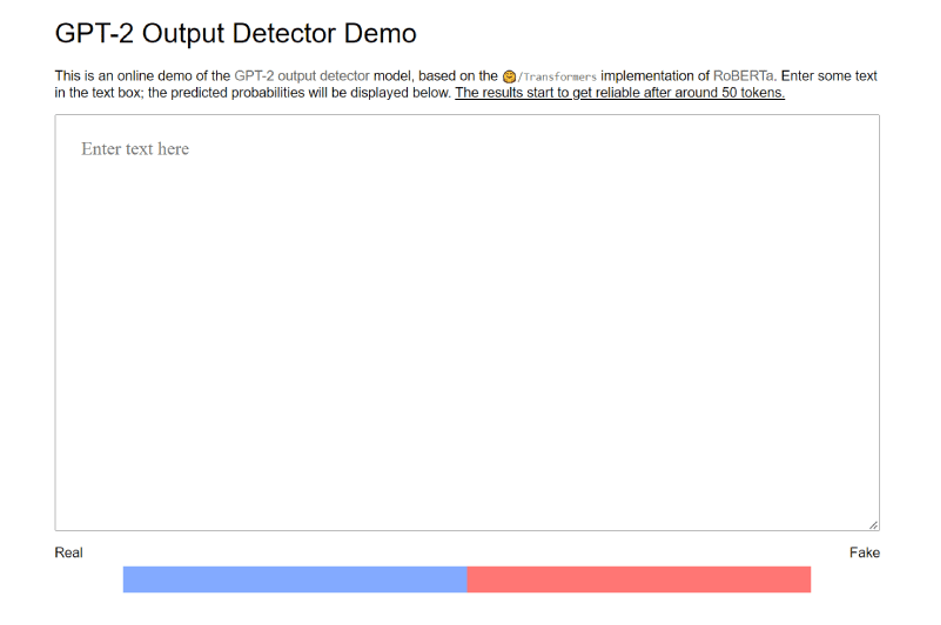
Hugging Face’s OpenAI Detector is a pre-trained natural language processing model that can classify and identify digital content. The OpenAI Detector has been taught to identify several forms of online misinformation, including spam, propaganda, and disinformation, by examining a massive database of web pages.
The model may filter or identify information on websites or social media platforms that may be hazardous or improper. OpenAI’s GPT-3 (Generative Pre-training Transformer 3) model is a state-of-the-art NLP model that has been trained on a huge dataset of text and serves as the basis for their Detector tool.
Key Features:
- Can easily identify the AI-generated content
- It can be accessed through an API or command line tools
- It classifies your content based on a large dataset of different web pages
- It helps in saving you from spam content with ease
Pros:
- Flags inappropriate content
- Based on GPT-3 model
Cons:
- It can be inaccurate sometimes
5. Detect GPT
Link: chrome.google.com/webstore/detail/detect-gpt
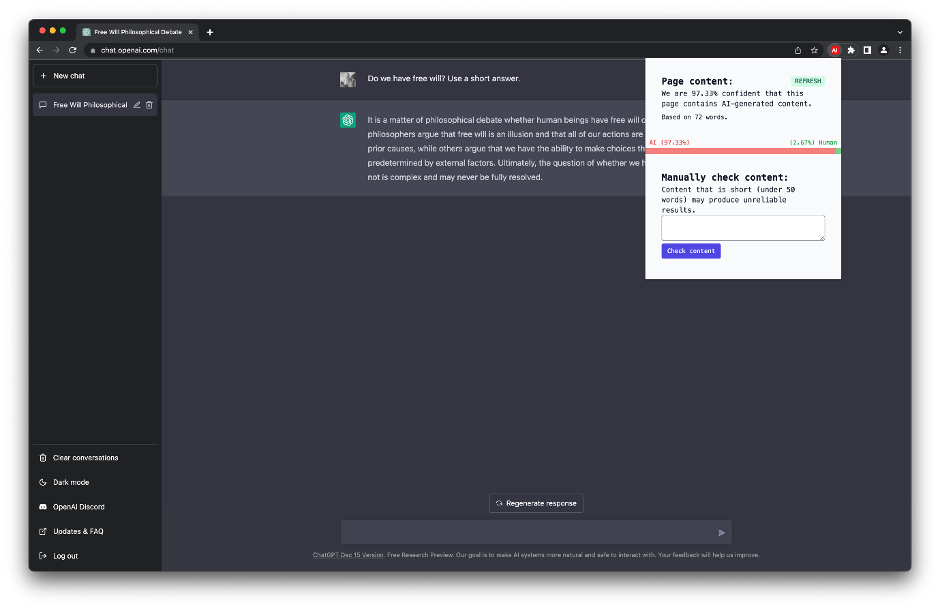
Detect GPT is another AI detector tool on our list that allows you to identify and classify AI-generated content. To determine whether any of the material on the current page was created using the GPT language model, Detect GPT does an in-depth analysis of the page’s source code and all of its components. It employs a detector developed by OpenAI and performs well on GPT3 and ChatGPT.
It’s not perfect, but it’s good enough to identify non-human-written information. In the future, when far more material will be created by artificial intelligence, this Chrome add-on is essential.
Key Features:
- You can access it through API and command line
- It uses a detector that was made by OpenAI
- It is a Chrome extension that works equally well for all other browsers
- Allows you to maintain the integrity of your site
Pros:
- Easy to use
- Works on ChatGPT
Cons:
- Not 100% accurate
6. AI Content Detector by Crossplag (Beta)
Link: crossplag.com
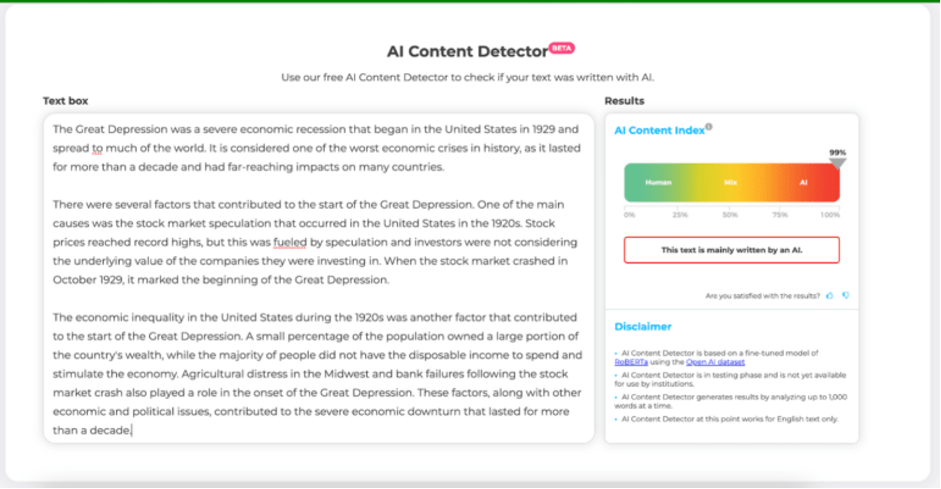
The AI Content Detector uses a mixture of machine learning algorithms and natural language processing methods to estimate the content’s source accurately. The tool is trained using a large corpus of both AI-generated and human-written text to recognize the unique patterns and features of each.
Websites with unique, real, and trustworthy responses perform better in search engine results, and these qualities cannot be delivered with an AI Generator. Using AI Content Detector by Crossplag, you can verify the authenticity and originality of the content you post online, which can boost your site’s search engine results.
Key Features:
- It allows you to keep the originality and authenticity of the content
- It lets you protect your website against AI generated content
- It can identify the patterns of text generated by AI
- It lets you avoid Google penalties for AI-generated content
Pros:
- Helps in maintaining the reliability
- Boost your site’s ranking
Cons:
- Prone to false positive flagging
Newly Added ChatGPT Detection Apps
- CheckForAI - Upload a document, get a score back instantly.
- GPTZero.me - Simple GPT detection tool with API.
- ZeroGPT.com

Update - OpenAI Releases Their Own ChatGPT Detection Tool
OpenAI has released their own free AI Detection Tool. The interesting thing is even OpenAI admits how unreliable the tool is - “it correctly identifies AI only 26% of the time, and gives a false positive 9% of the time.” There are other known limitations including it is unreliable on short texts below 1,000 characters, only works on English, and editing the AI text can make it undetectable.
Conclusion
ChatGPT detector apps are useful tools for identifying and classifying various types of content, including spam, propaganda, plagiarism and of course ChatGPT and other AI produced content. This can be extremely important to make sure you do not run afoul of Google and get flagged for AI produced content. As of now, some of the Best AI Detector Apps for 2025 in the market include Grammarly, Originality.ai, and Hugging Face. Each is worth checking out and testing with their low price points to see which seems most accurate and easy to use to you. This is a rapidly evolving market and a cat and mouse game between AI content generators, detection tools, and perhaps search engines. It is still likely worth running your content through an AI Detection Tool.